Other notable mosques that we visited include Hagia Sophia, Eyup Sultan Mosque, Sultan Ahmed Mosque (Blue Mosque), and Yeni Mosque (New Mosque). I am not including pictures of all of those mosques in this blog, because it rained one day and I did not carry a camera, another day I forgot the camera, a couple Pat did not get to visit because she gave a presentation at a conference and I don't want to rub it in, and you cannot take pictures inside the mosques anyway. If you only have time to visit one mosque, visit both Hagia Sophia and the Blue Mosque. The immenseness and history of Hagia Sophia is simply amazing, and the thousands of blue tiles in the Blue Mosque are absolutely beautiful.
Sunday, November 8, 2009
Istanbul 5--Suleymaniye Mosque
Frequently consider one of the four greatest mosques in Istanbul, Suleymaniye Mosque was designed to compliment Hagia Sophia, which was built a thousand years before. Below are several pictures of Suleymaniye Mosque. The interior of the mosque was closed for renovation.


Istanbul 4--Topkapi Palace
Under the direction of Sultan Mehmed II, conquerer of the Constantine Empire, construction started on Topkapi Palace about 560 years ago, and continued for the next 400 years. I found this palace to be nothing like the palaces in western civilizations. There are no internal hallways. Instead, the palace consists of huge courtyards surrounded by covered walkways connecting to rooms. In later years, buildings were added in the middle of the courtyards for specific purposes, for example the library, and the throne room is actually a throne building. There are thousands of antiquities stored throughout the palace, including lining the walls of the open-air walkways.

I also visited the Dolmabache Palace, which was built by the Ottoman Empire's 31st sultan, because the Ottoman Empire was beginning to decline in power because the development of oceanic shipping transportation was diminishing Istanbul's cross-roads trade. So the plan was to build a western-style palace to entertain European leaders. The Dolmabache Palace is absolutely the most fabulous palace I have ever seem. It makes the Palace of Versailles seem unremarkable. Anyway, the construction of the Dolmabache Palace was such a financial strain on the Ottoman Empire that instead of facilitating opportunity by reopening European trade, it accelerated the empire's spiral into economic ruin. Ironic, eh?
The rooms throughout the palace are decorated with exceptionally exquisite detail, using gold, gems, beautiful tiles and delicate mosaics.


When you go there, pay the extra 15 TL to follow these people on a tour of the Topkapi Palace Harem. It's a good way to invigorate your imagination.

Istanbul 3--Bosphorus Strait
Pat's conference, ESERA, hosted a cruise on the Bosphorus Strait. Here are some pictures of Istanbul from that cruise.

Note the mixture of 19th and 20th century apartment buildings with the shining new office tower. In the foreground is the Katabus sea shuttle port. Each of those ferries can hold about 1500 passengers. Every day, more than a million people cross the Bosphorus Strait via ferry to go to work. It costs 1.5 TL (Turkish Lire) each way, which is about 95 cents.

A small mosque on the waterfront. I went in this one. It is bedazzled with gold, and shining blue and white tiles.

One of many mansions on the Asian waterfront.

Note the little, old fortress behind the modern mansions.

This mansion dates back to the Ottoman Empire.

This is a university...all housed in one really big building.

One of many mansions on the Asian waterfront.
Note the little, old fortress behind the modern mansions.
This mansion dates back to the Ottoman Empire.
This is a university...all housed in one really big building.
This was the sultans' summer home during the 19th century. It is on the Asian side of the strait.

This is a fish for a family meal Pat and I ordered and devoured at a restaurant on the lower level of the Galata Bridge, which connects Old City and New City. Eight different types of fish. All fried. Be still my heart. When it was served, there was an oil-fed, wild fire burning in the aluminum thing in the middle. We were eating outside over the water, it was breezy and the flame was high. I thought the waiter was going to catch on fire.

This is taken from the fish market, looking toward Old City. Suleymaniye Mosque is on the left. From here, we walked up hundreds of steps and zigzagged up the tiniest and curviest streets to Galata Tower.

This is a fish for a family meal Pat and I ordered and devoured at a restaurant on the lower level of the Galata Bridge, which connects Old City and New City. Eight different types of fish. All fried. Be still my heart. When it was served, there was an oil-fed, wild fire burning in the aluminum thing in the middle. We were eating outside over the water, it was breezy and the flame was high. I thought the waiter was going to catch on fire.
This is taken from the fish market, looking toward Old City. Suleymaniye Mosque is on the left. From here, we walked up hundreds of steps and zigzagged up the tiniest and curviest streets to Galata Tower.
Istanbul 2--Spice Bazaar & Fish Market
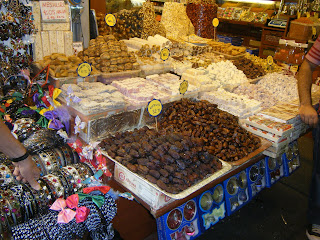
The Spice Bazaar is the second largest and perhaps oldest marketplace in Istanbul. In addition to oodles and oodles of shops selling spices, there are bazillions of shops selling a wide variety of things, from jewelry to meats and sausages.

Dates, fruits, nuts and all kids of delicious things are sold by bulk in the Spice Bazaar.
Literally, there are hundreds of shops that sell spices. Pat paid 20 TL per gram for fresh saffron. I bought a special Turkish barbeque spice mix. Hungry? Come over, and I will fire up the grill.

Pat is grinning with exploratory jubilation just before we enter the Spice Bazaar.

There was a whole row of restaurants near the Spice Bazaar and the New Mosque on the waterfront. Interestingly, the kitchens were on boats that tossed wildly in the huge wakes caused by the big ferry boats. The diners, however, enjoyed the comfort of shade and the stability of dry land.

This is a picture of Galata Tower, taken from the gateway to the Spice Bazaar. The tower is over 1650 years old and nine stories tall. It is located at the foot of Istiklal Avenue (Independence Avenue), and is the pride of the New City skyline. There is a restaurant on the eighth floor and a night club on the top floor.

This is the fish market. There is no better place to buy fresh fish.


This is what I am going to call a typical Istanbul restaurant meal. It consists of ground lamb, fried fish, roasted chicken, flat bread, onions, tomatoes and cucumbers. Because of European influences, fries are served with almost every meal.

This is me. Well, a picture of me. I am standing in front of one of the seven entrances to the Grand Bazaar, which houses more than 4000 shops. After the Ottoman's conquered Istanbul, rather than evict or enslave the residents, Sultan Mehmed II invited those who fled back into the city to live, work and trade. Encouraging Armenians, Greeks and Romans to move to Istanbul, the sultan also created the Grand Bazaar to foster trade. Today, you cannot take three steps in the Grand Bazaar without being pestered by salesmen (yes, they are all male) trying to lure you into their shops. All prices are negotiable at the Grand Bazaar. But don't worry, no matter how good of a negotiator you think you are, you're going to be gouged; enjoy the cultural immersion.
Dates, fruits, nuts and all kids of delicious things are sold by bulk in the Spice Bazaar.
Literally, there are hundreds of shops that sell spices. Pat paid 20 TL per gram for fresh saffron. I bought a special Turkish barbeque spice mix. Hungry? Come over, and I will fire up the grill.
Pat is grinning with exploratory jubilation just before we enter the Spice Bazaar.
There was a whole row of restaurants near the Spice Bazaar and the New Mosque on the waterfront. Interestingly, the kitchens were on boats that tossed wildly in the huge wakes caused by the big ferry boats. The diners, however, enjoyed the comfort of shade and the stability of dry land.
This is a picture of Galata Tower, taken from the gateway to the Spice Bazaar. The tower is over 1650 years old and nine stories tall. It is located at the foot of Istiklal Avenue (Independence Avenue), and is the pride of the New City skyline. There is a restaurant on the eighth floor and a night club on the top floor.
This is the fish market. There is no better place to buy fresh fish.
This is what I am going to call a typical Istanbul restaurant meal. It consists of ground lamb, fried fish, roasted chicken, flat bread, onions, tomatoes and cucumbers. Because of European influences, fries are served with almost every meal.
This is me. Well, a picture of me. I am standing in front of one of the seven entrances to the Grand Bazaar, which houses more than 4000 shops. After the Ottoman's conquered Istanbul, rather than evict or enslave the residents, Sultan Mehmed II invited those who fled back into the city to live, work and trade. Encouraging Armenians, Greeks and Romans to move to Istanbul, the sultan also created the Grand Bazaar to foster trade. Today, you cannot take three steps in the Grand Bazaar without being pestered by salesmen (yes, they are all male) trying to lure you into their shops. All prices are negotiable at the Grand Bazaar. But don't worry, no matter how good of a negotiator you think you are, you're going to be gouged; enjoy the cultural immersion.
Istanbul 1
This is the entrance to the Istanbul Metropolitan City Hall. Despite housing some remarkable antiquities, we did not go in there. We had to save something for our return trip.


Ooooooh. The dark, mysterious and eerie cistern. Literally and figuratively, it is cool down there.

Hagia Sophia. One of the greatest buildings ever built anywhere. First a church, then a mosque and now a museum. It was the largest cathedral on Earth for over a thousand years. Taking pictures was not allowed inside the building. Hit the link and read about this building. The history is absolutely amazing, and it is absolutely amazing that this huge building was built 1500 years ago.

Fancy pastries at one of the many pastry shops on Istiklal Avenue. We cannot go anywhere without taking a picture of pastries for our pastry chef daughter. It's a rule. There you go, Claire.
I never did find out what the story is behind lady bug pastries, but they were as common as the bugs, themselves.

Istiklal Avenue connects Taksim Square with Galata Tower in the New City. For Istanbul, it is a rather wide road. A tram runs up and down its center. When walking down the street, watch your back. Also called Independence Avenue, the street houses many upscale shops, as well as many embassies. This building is an outstanding example of art nouveau architecture.

We were in Istanbul during Ramadan. As dusk came, tens of thousands of people poured into Istiklal Avenue.

This is the Ataturk Statue, commemorating Turkey's independence from the Ottomans.

Pigeons playing with Pat at Taksim Square.
This picture was taken in the Basilica Cistern, which was built 1500 years ago to store water for them thirsty Byzantines. The cistern covers the area of three football fields. The water came from the Belgrade Woods via a 12-mile aqueduct. Over 330 columns support the roof. The Basilica Cistern is located near Hagia Sophia. For hundreds of years, private residents stood on top of the cistern. Today, there is a park. Because of their variety of design, it is believed that the columns were recycled from buildings that had fallen into ruin or were destroyed in earthquakes. Pat is pictured standing behind one of two columns that have a Medusa's head carved on the base. No one knows why this one is upside down. The other is sideways, and probably turned that way to provide the right base heighth.
Ooooooh. The dark, mysterious and eerie cistern. Literally and figuratively, it is cool down there.
Hagia Sophia. One of the greatest buildings ever built anywhere. First a church, then a mosque and now a museum. It was the largest cathedral on Earth for over a thousand years. Taking pictures was not allowed inside the building. Hit the link and read about this building. The history is absolutely amazing, and it is absolutely amazing that this huge building was built 1500 years ago.
Fancy pastries at one of the many pastry shops on Istiklal Avenue. We cannot go anywhere without taking a picture of pastries for our pastry chef daughter. It's a rule. There you go, Claire.
I never did find out what the story is behind lady bug pastries, but they were as common as the bugs, themselves.
Istiklal Avenue connects Taksim Square with Galata Tower in the New City. For Istanbul, it is a rather wide road. A tram runs up and down its center. When walking down the street, watch your back. Also called Independence Avenue, the street houses many upscale shops, as well as many embassies. This building is an outstanding example of art nouveau architecture.
We were in Istanbul during Ramadan. As dusk came, tens of thousands of people poured into Istiklal Avenue.
This is the Ataturk Statue, commemorating Turkey's independence from the Ottomans.
Pigeons playing with Pat at Taksim Square.
Subscribe to:
Posts
(
Atom
)